
Seed and mulch for Central Texas ground
Hydroseeding in Austin, TX
New lawns, bare lots and eroding slopes, sprayed for thin limestone soil, heavy black clay and a long, hot growing season.
- Free on-site measuring and a written, itemized quote
- Seed picked for your soil: Hill Country rock or Blackland clay
- Erosion and silt fence work planned around TCEQ and city rules
Seeding Both Sides of the Balcones Fault
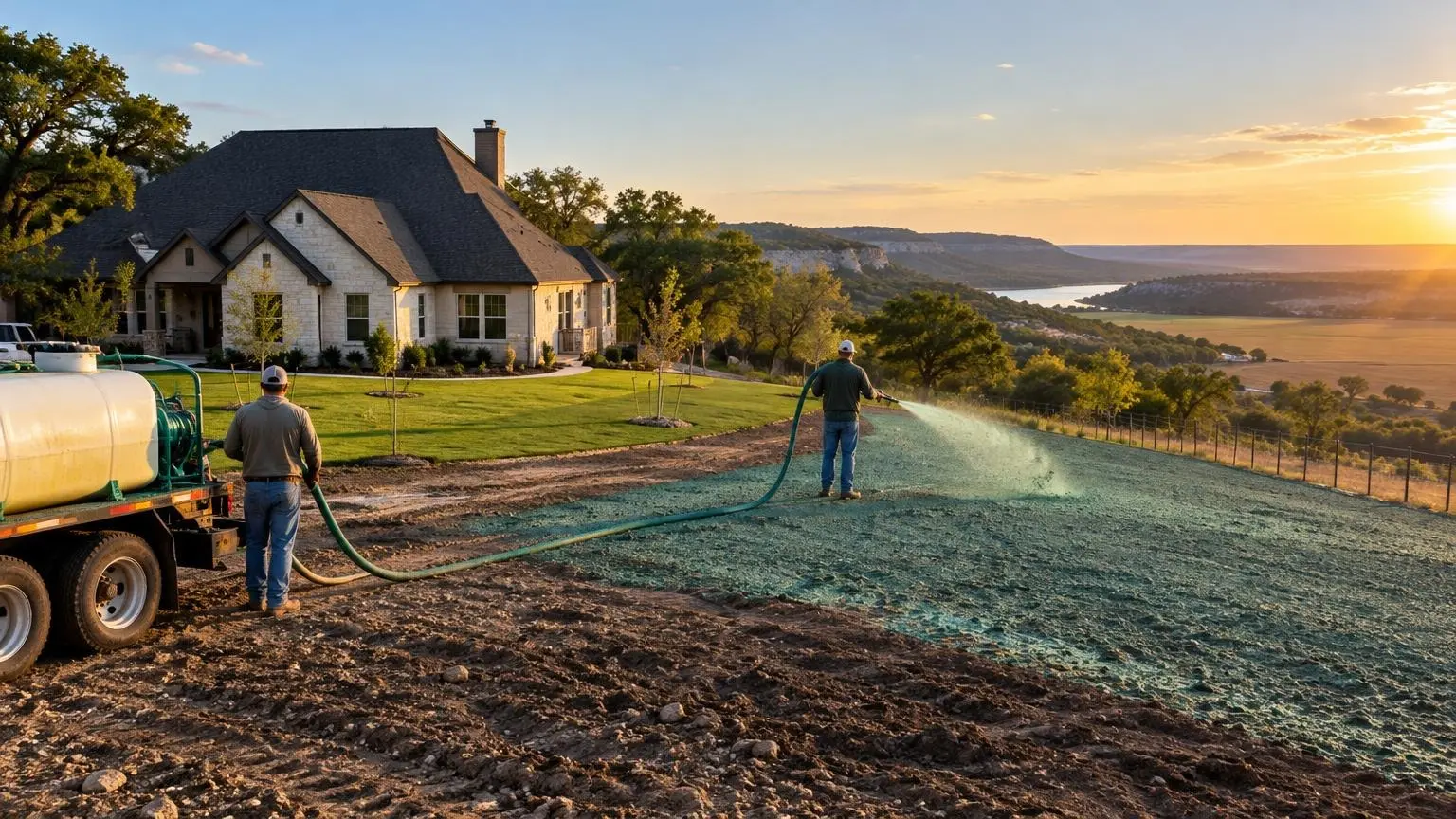
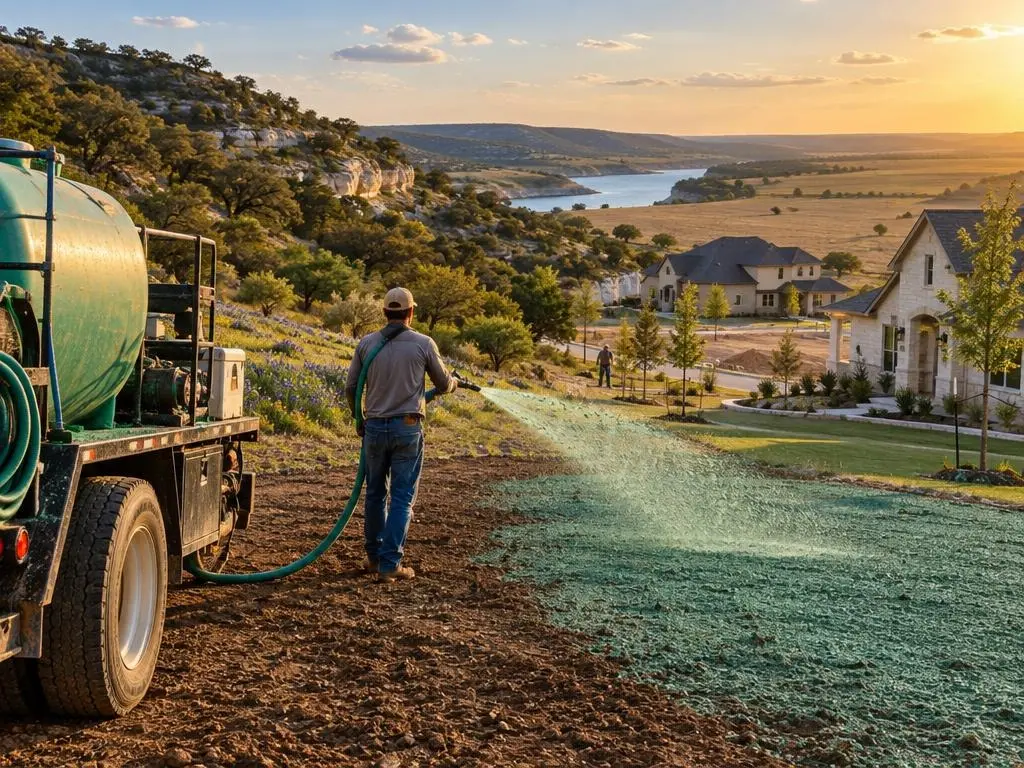
Hydroseeding in Austin starts with one question: which side of the fault is your yard on? Our trucks mix seed, wood fiber mulch, fertilizer and tackifier into a wet slurry and shoot it onto prepared ground for new lawns, builder lots, commercial sites and slopes across Austin and the towns around it. The mix sticks to the soil, holds moisture against the seed and shields bare ground from the next downpour. Done right, a hydroseed lawn is cheaper than sod and far more reliable than seed thrown by hand. Done on the wrong soil or in the wrong month, it washes off or cooks. Most of what we know about doing it right here comes down to rock, clay and heat.
Two kinds of ground under one city
Austin sits at the foot of the Balcones Escarpment, and the city's elevation runs from about 425 feet to roughly 1,000 feet. The Balcones Fault splits it in two. The eastern part of the city is mostly flat, with heavy clay and loam soils. The western part and the western suburbs are rolling hills at the edge of the Hill Country, built mostly on limestone with a thin covering of topsoil. The soils follow the same line: shallow, gravelly clay loams over limestone on the western outskirts, and deep fine sandy loams, silty clay loams, silty clays and clays on the east side. Many of them, especially the clay-rich ones, are slightly to moderately alkaline and carry free calcium carbonate.
For seeding, that means two different jobs. In the hills, the problem is depth. Seed needs something to root into, and four inches of soil over rock dries out in a day in July. We often bring in topsoil and spray a heavier mulch rate so moisture lasts longer. On the clay to the east, the problem is texture and movement. Clay seals over when it is pounded by rain, then cracks open as it dries.
Blackland clay
Parts of Travis and Williamson counties, including the flat farm country around Hutto and Taylor, lie in the Texas Blackland Prairie, named for its dark, alkaline clay. Locals have called it black gumbo. Houston Black, the Texas state soil, covers more than 1.5 million acres of that prairie and is a classic shrink-swell clay. In dry weather deep cracks open in it, and water erosion is one of the main problems on it. The Austin Wikipedia article puts it plainly: some of these clays are difficult to work under most moisture conditions. We time grading for when the clay will crumble rather than smear, keep seed shallow, and use enough fiber mulch to keep a crust from forming over the seed.
Heat, storms and the seeding calendar
The 1991 to 2020 normals for Camp Mabry show highs of 90 degrees or more on about 123 days a year, with 29 of those reaching 100. The average daytime high stays at 90 or above from about May 30 to September 18. Average first and last freezes fall around December 1 and February 15, which gives Austin a growing season of about 288 days. Rain averages roughly 36 inches a year at Camp Mabry, with May the wettest month at about 5 inches and July one of the driest at about 2.
Austin lawns are warm-season grasses. Bermuda grass, the usual choice for a sunny seeded lawn, starts actively growing above about 59 degrees and does best between about 75 and 99, then goes dormant and turns light brown in winter. That points to a spring window: once nights warm in April, through May and into June, so the grass is established before the long 90-degree stretch. Early fall can work too, but a lawn seeded late has only a few weeks before the first freeze sends it dormant. When a lot has to be covered in late fall or winter, we usually spray hydromulch to hold the soil and come back to seed in spring.
Flash floods and why bare dirt matters here
Because the western hills are mostly limestone with little soil on top, thunderstorm runoff comes off them fast, and parts of the city flood often. In October 2018, after heavy rain, the Highland Lakes that supply the city's water filled with silt, dirt and debris washed in from the Llano River, and Austin was under a boil-water advisory from October 22 to 29. Austin Watershed Protection, set up in 1996 as the Drainage Utility, exists to cut flooding, erosion and water pollution. The city and Travis County are also redrawing floodplain maps: current maps use 10.2 inches of rain in 24 hours for the 100-year storm, and the updated ones use almost 13 inches in some areas. A bare lot in this climate is a sediment problem waiting for one storm. Seeding it, mulching it or fencing it is how you stop that.
Permits, the aquifer and sediment control
In Texas, construction that disturbs an acre or more and drains to surface water falls under the TCEQ Construction General Permit, TXR150000, which took effect March 5, 2023. Operators must have a Stormwater Pollution Prevention Plan written, and follow it, before the first dozer moves. West of town there is another layer. The Edwards Aquifer recharge zone follows the Balcones Fault north to Austin, a few miles west of I-35, and its karst limestone can carry pollutants through the aquifer in hours to days. TCEQ says anyone clearing or building in the recharge and contributing zones in Hays, Travis or Williamson County has to contact its Austin regional office about Edwards Aquifer program rules. Our silt fence, inlet protection and erosion control services exist for exactly this kind of site, and we install them to the plan the engineer or builder hands us.
Sod vs hydroseed vs dry seed
Sod gives you grass on day one, but HomeGuide's figures for laying sod run $1 to $4 a square foot, while hydroseeding comes in at $0.12 to $0.35. It also needs heavy watering in summer and can shrink at the seams on cracking clay. Plain lawn seeding with dry seed broadcast by hand is cheapest, but it blows away, washes into the gutter in the first storm and dries out fast on our soils. Extension researchers at the University of Nebraska found hydroseeded grass generally shows in 5 to 7 days, where dry-sown seed takes two to three weeks to come up. Hydro seeding sits in between on price, covers slopes that sod crews struggle with, and puts mulch over every seed. On new lawn installation for a typical Austin lot, that balance is why most of our customers pick it.
What a job looks like
- We measure, check soil depth and slope, and find where water runs
- Grading, topsoil and any silt fence go in first
- The seed mix is chosen for sun, soil and how the yard is used
- We spray seed, mulch and fertilizer in one even coat
- You get written watering steps for the first three weeks
- We answer the phone when you have a question about how it is coming in
Why Homeowners Call Elite Hydroseeding Austin
Seed matched to the soil
Thin rock in the hills and heavy clay out east need different prep, mulch rates and seed. We look before we pick.
Timed to the warm-season calendar
We plan lawns for the spring and early summer window and tell you plainly when a late-season job should be mulch now and seed later.
Sediment control on the same crew
Silt fence, inlet protection, blankets and hydromulch come from the same company that seeds, so the site is held from grading to grass.
Quotes you can read
Square footage, seed mix, mulch, topsoil and fence footage are listed line by line, so there is nothing to guess about.
Common Questions
Is hydroseeding worth the money in Austin?
For most bare yards, yes. It costs a fraction of sod (HomeGuide's range is $0.12 to $0.35 a square foot for a hydroseeded lawn, compared with $1 to $4 for sod), and the mulch layer protects seed from heat and storm runoff far better than dry seed. The trade-off is time: you wait several weeks for a mowable lawn instead of laying it in a day.
What is the best grass to grow in Austin, Texas?
It depends on sun and water. Bermuda is the common pick for full-sun lawns because it grows hard in heat and recovers by runners. Buffalograss, a native prairie grass used for low-water lawns, is worth a look where irrigation is limited. Heavily shaded yards are a different conversation, and we will tell you if seed is the wrong tool there.
Is October too late to hydroseed in Austin?
For a warm-season lawn, usually yes. Austin's average first freeze is around December 1, and Bermuda slows down as nights cool, so October seed often goes into winter thin. If the ground cannot sit bare, we spray hydromulch or a temporary cover now and seed the lawn in spring.
Where does Austin's water come from, and does that affect my lawn?
The city's main supply is the Highland Lakes on the Colorado River. In 2018 storm runoff loaded those lakes with silt and the city went on a boil-water advisory for a week. That is one reason we push to cover bare soil quickly, and why we recommend grasses that can get by on less water once established.
How soon will I see grass after hydroseeding?
Under good conditions, the first green from a hydroseeded yard tends to appear in 5 to 7 days (University of Nebraska Extension and HomeGuide). Expect the first mow at around 4 to 6 weeks. Cool spells, shade or missed watering stretch that out.
How do I water a new hydroseed lawn in Austin heat?
Keep the top of the soil damp, not flooded. Iowa State Extension's guidance for new seed is two light waterings a day in most weather and up to four in hot, windy weather, for about three weeks. On our clay, short cycles soak in better than one long run that sheets off.
Will hydroseed stick on the black clay east of town?
Yes, if the clay is prepared at the right moisture. Worked too wet it smears and seals; worked too dry it is clods. We grade when it crumbles, roughen the surface and use enough mulch and tackifier to keep a crust from forming over the seed.
Our Services
Six kinds of work, from the first grade to the last strand of silt fence, for homes, builders and open land around Austin.
Hydroseed Lawn Installation
New hydroseed lawns for new builds, bare yards and renovations, with seed matched to Austin's sun and soil.
Learn more →Builder & Commercial Hydroseeding
Hydroseeding for subdivisions, commercial pads, detention ponds, road shoulders and utility corridors.
Learn more →Slope & Channel Erosion Control
Erosion control blankets, hydromulch and seeding for slopes, swales, ditches and creek banks.
Learn more →Silt Fence & Inlet Protection
Silt fence, curb inlet protection and other sediment barriers for Austin building sites, remodels and land clearing.
Learn more →Fine Grading & Topsoil Prep
Fine grading, lot and yard regrading, topsoil and dirt work that gets Austin ground draining right and ready for seed.
Learn more →Native Grass & Wildflower Seeding
Native grass seeding and wildflower seeding for acreage, slopes, open space and low-water yards.
Learn more →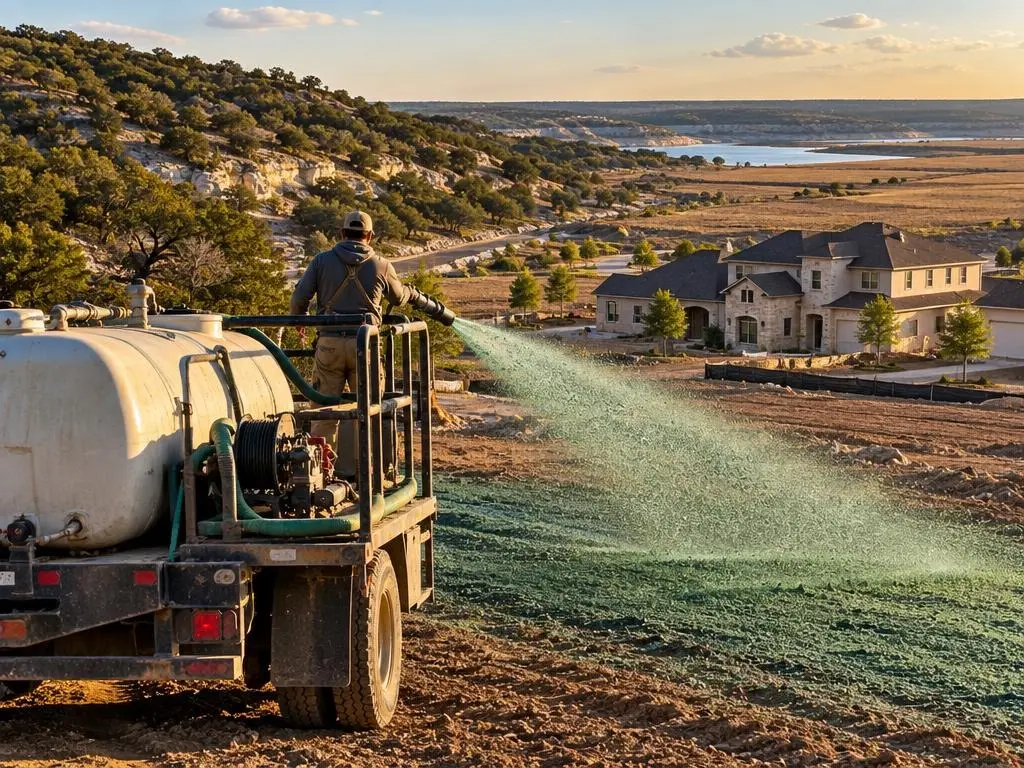
From the Lake Travis Hills to the Prairie Towns
We work in Austin and across Travis, Williamson, Hays, Bastrop and Caldwell counties, plus the Highland Lakes. The western side is hill country: Lakeway, Lago Vista and Jonestown on the slopes around Lake Travis, Dripping Springs and Wimberley on acreage and creek valleys, and Marble Falls up on the granite and lake country. North along I-35 and the toll roads, Round Rock, Cedar Park, Leander and Georgetown mix limestone, karst and fast-growing subdivisions. To the east, Pflugerville, Hutto, Taylor, Manor and Elgin sit on flatter prairie clay with lots of new streets and builder lots. South, Buda, Kyle, San Marcos and Lockhart straddle creeks that run hard after storms, and Bastrop sits beside the loblolly pines of the Lost Pines. Every town page has its own soil, water and growth notes, and we seed each lot for what is actually under it.
- Hydroseeding in Austin, TX
- Hydroseeding in Round Rock, TX
- Hydroseeding in Cedar Park, TX
- Hydroseeding in Leander, TX
- Hydroseeding in Georgetown, TX
- Hydroseeding in Pflugerville, TX
- Hydroseeding in Hutto, TX
- Hydroseeding in Taylor, TX
- Hydroseeding in Elgin, TX
- Hydroseeding in Manor, TX
- Hydroseeding in Bastrop, TX
- Hydroseeding in Kyle, TX
- Hydroseeding in Buda, TX
- Hydroseeding in San Marcos, TX
- Hydroseeding in Wimberley, TX
- Hydroseeding in Dripping Springs, TX
- Hydroseeding in Lakeway, TX
- Hydroseeding in Lago Vista, TX
- Hydroseeding in Jonestown, TX
- Hydroseeding in Marble Falls, TX
- Hydroseeding in Lockhart, TX
Have Us Measure Your Bare Ground
Tell us where the site is and what it needs. We will come out, measure, and put the price in writing.